en people talk about the latest generation of humanoid robots—such as the advanced platforms developed by Figure AI or the continuous evolution of Tesla Optimus—the spotlight is usually on AI, vision systems, and software algorithms.
But for engineers working behind the scenes, the real challenge is far less glamorous: actuation design.
How do you pack enough torque into a human-proportioned robot without turning it into a 200-kilogram machine? How do you balance strength, precision, weight, and durability in a structure that must both walk and perform delicate manipulation?
After working closely with robotics development teams, one recurring mistake stands out: many early-stage humanoid designs try to use the same joint actuator strategy for both arms and legs.
This is a fundamental engineering error.
Arms and legs experience completely different load conditions. If you treat them as the same mechanical system, the result is usually predictable: poor precision in the arms or premature gearbox failure in the legs.
Here is a clearer and more practical approach to humanoid arm vs. leg joint design.
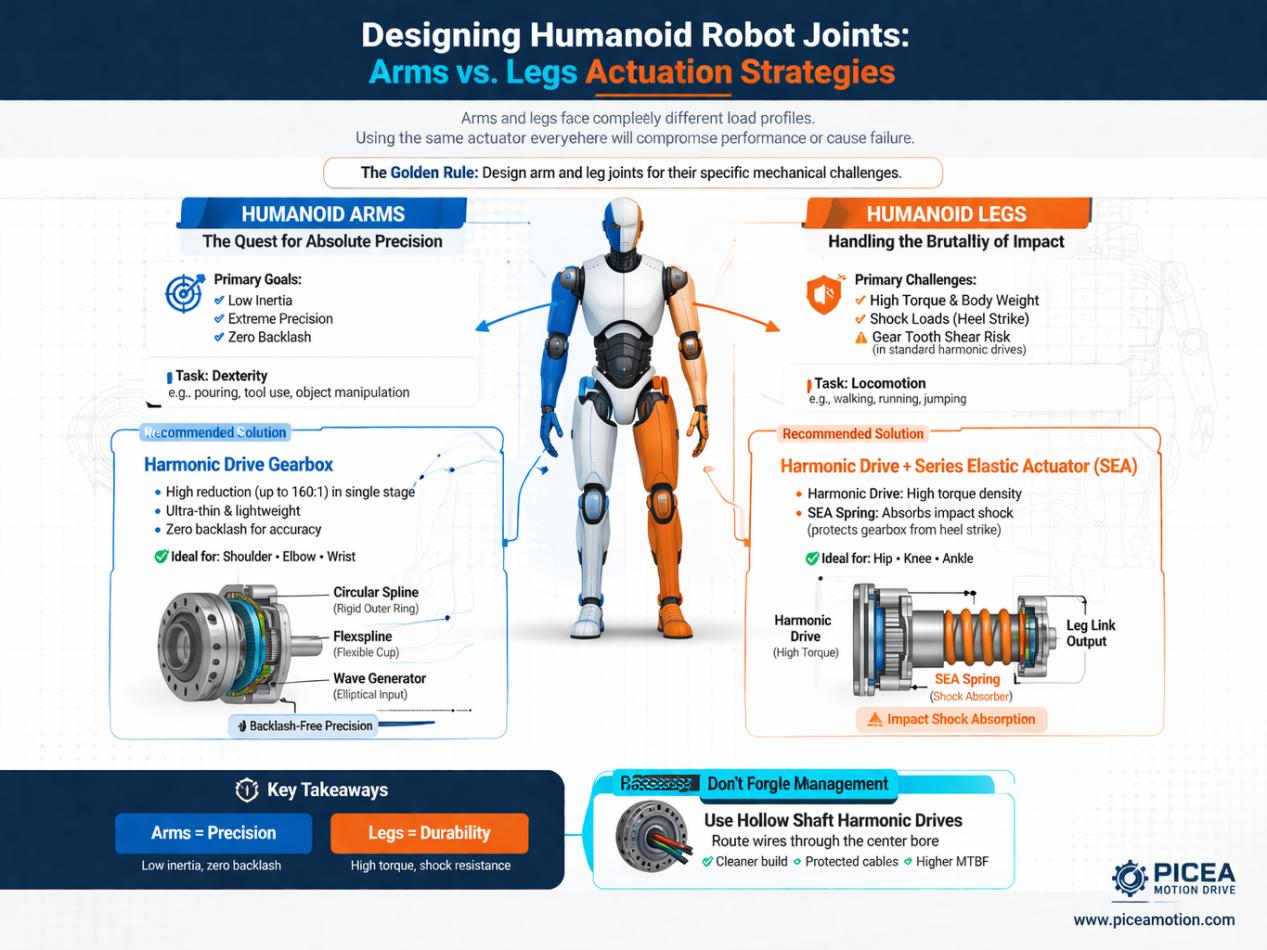
When designing shoulder, elbow, and wrist joints, the main engineering targets are:
Extremely low inertia
High positioning accuracy
Smooth motion control
Minimal backlash
Humanoid robot arms are not just for lifting objects. They must perform human-level precision tasks, such as assembling small parts, using tools, or interacting safely with humans. To achieve this, the arm must move quickly while remaining lightweight.
However, using traditional multi-stage planetary gearboxes in arm joints often creates a major problem: excessive weight. The servo motor ends up consuming most of its power simply to move the arm itself, leaving very little capacity for payload or precise control.
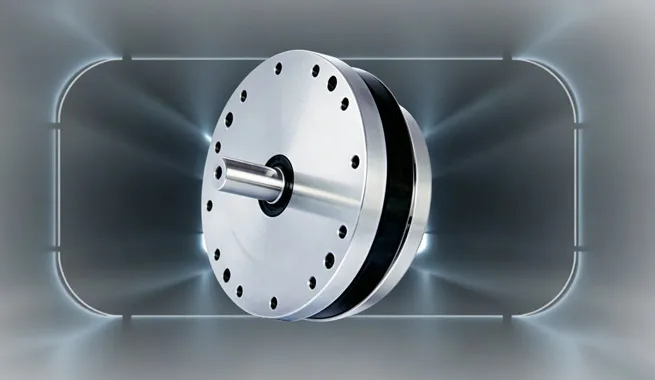
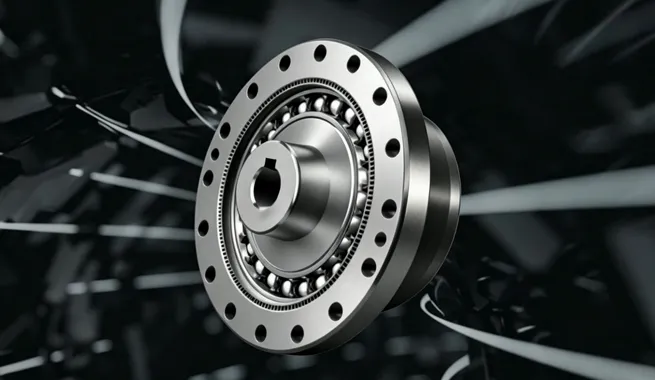
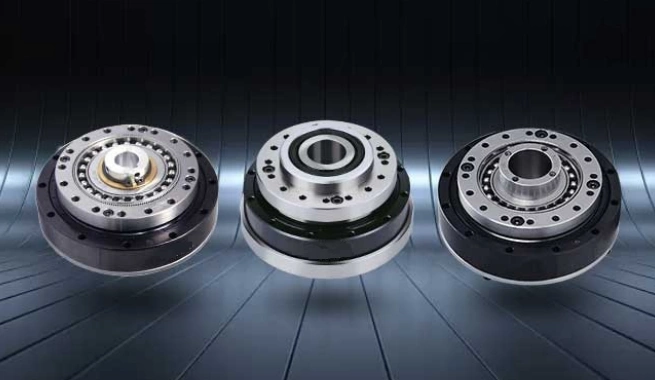
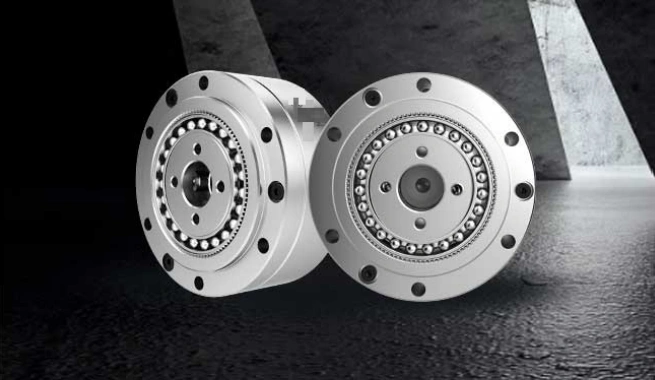
This is why harmonic gearbox gearboxes for robotic arms are widely considered the optimal solution.
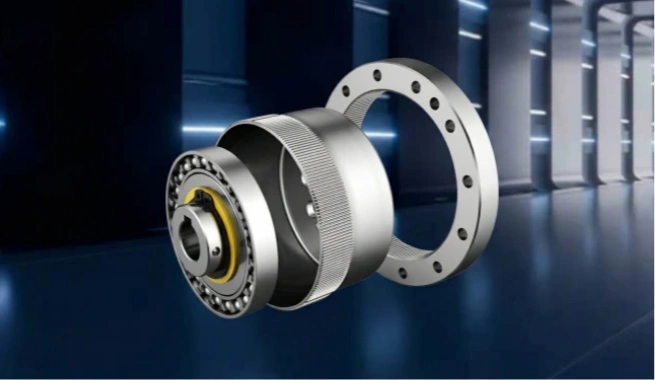
Because harmonic gearboxs use a flexible flexspline instead of bulky rigid gears, they can provide:
Very high reduction ratios (up to 160:1) in a single stage
Ultra-compact and lightweight structure
Near-zero backlash
High positioning accuracy
Even a small amount of backlash in a shoulder or elbow joint can cause large positioning errors at the end effector. Harmonic gearboxs maintain continuous tooth engagement, ensuring that the robot arm moves exactly as the kinematic model predicts.
Leg joints—especially hips, knees, and ankles—face a completely different challenge.
A humanoid robot leg must not only support the entire body weight but also withstand repeated impact forces during walking or running. Every step generates a strong shock load when the foot strikes the ground, and this force travels directly through the gearbox.
This is where many designs fail.
Standard harmonic gearboxs are excellent for precision motion, but the flexspline is intentionally thin. Under severe dynamic shock, the gear teeth may deform or fail prematurely. Simply installing the same harmonic gearbox used in an arm into a knee joint can significantly reduce the system’s reliability.
So what is the correct solution?
The most successful humanoid robot architectures today do not rely on rigid actuation alone. Instead, they combine:
High-torque harmonic gearboxs
Series Elastic Actuators (SEA)
Mechanical shock absorption
By placing a calibrated spring or elastic element between the gearbox output and the leg link, the system absorbs the impact generated during heel strike. This reduces peak stress on the gear teeth while still allowing the actuator to deliver high continuous torque.
The benefits are clear:
Longer gearbox lifespan
Improved walking stability
Better force control
Reduced mechanical failure risk
In short, arms require precision, while legs require durability—and the actuation strategy must reflect that difference.
Another critical but often overlooked factor in humanoid robot design is wiring.
A typical humanoid robot may have more than 40 degrees of freedom (DoF). This means dozens of cables must run through constantly rotating joints. If these cables are routed externally, they can easily stretch, twist, or break over time.
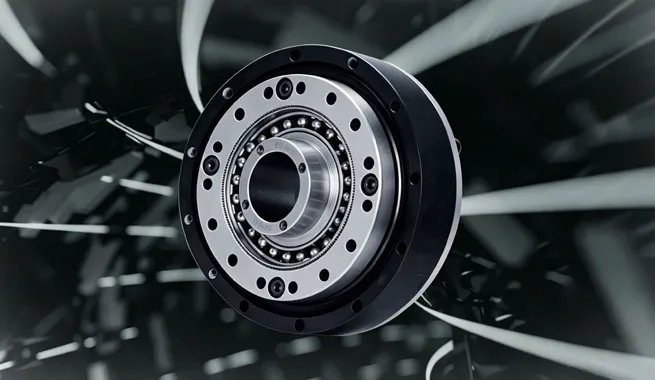
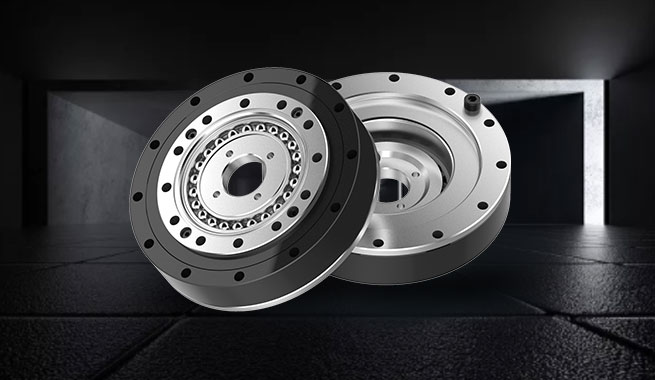
That is why hollow-shaft harmonic gearboxs are becoming increasingly popular in humanoid robots.
A hollow shaft design allows engineers to route power lines, encoder wires, and communication cables directly through the center of the joint. This approach offers several advantages:
Cleaner mechanical structure
Better protection for internal wiring
Reduced maintenance requirements
Longer system reliability (higher MTBF)
Moving from a research prototype to a commercially viable humanoid robot requires precision—not just in motion control, but also in actuator selection.
Over-engineering every joint increases cost and weight. Under-engineering leads to catastrophic mechanical failures. The key is selecting the right reduction ratio, torque capacity, and shock tolerance for each specific joint.
At Picea Motion Drive, we work closely with robotics teams to develop high-performance precision motion solutions tailored specifically for humanoid applications—from lightweight arm actuators to high-impact leg joint reducers.
If you are currently designing a humanoid robot platform, the most important step is not choosing one actuator for everything—it is choosing the right actuation strategy for each joint.
Contact us today to discuss your project requirements and find the perfect harmonic drive solutions.
Contact Us Now
Hi, I am Sophie from Shenzhen PICEA Motion Technology Co, Ltd. I have been working in overseas business trade for more than 5 years. PICEA Motion is a professional manufacturer of precision harmonic gears. Our company integrates R&D, production, sales, and after-sales services.