The manufacturing landscape is undergoing a profound paradigm shift. Industry 4.0 has ushered in an era where automation is no longer confined to isolated safety cages. Instead, we are witnessing the rapid proliferation of Collaborative Robots, universally known as "cobots." Designed to operate safely in close proximity to human workers, cobots are transforming assembly lines, packaging facilities, and even medical operating rooms by blending human cognitive adaptability with robotic precision and endurance.
However, the transition from traditional, heavy-duty industrial robots to lightweight, highly dexterous cobots presents formidable engineering challenges. A cobot must be lightweight enough to safely arrest its motion upon detecting human contact, yet rigid and precise enough to perform micro-level assembly tasks. Achieving this delicate balance relies entirely on the design of the robotic joints.
At the very core of these joints lies the transmission system. To meet the stringent demands of modern robotics, engineers are increasingly moving away from conventional planetary gearboxes and embracing advanced strain wave reducers. In this comprehensive guide, we will explore the mechanical intricacies of robotic joint design, analyze the limitations of traditional gearing, and dive deep into why high-precision, cup-type strain wave technology is the ultimate solution for next-generation cobot optimization.
Before delving into transmission mechanics, it is essential to understand what makes a cobot joint fundamentally different from a traditional industrial robotic arm joint.
Traditional robots rely on massive cast-iron or heavy aluminum structures. Their goal is maximum speed and payload, and safety is achieved by physical barriers. Cobots, governed by strict safety standards like ISO/TS 15066, rely on force and power limiting. To minimize kinetic energy—which dictates the severity of a potential impact with a human operator—the overall mass of the robotic arm must be kept strictly to a minimum.
Because the arm itself must be lightweight, the internal components (motors, brakes, encoders, and gearboxes) must offer an exceptionally high power density. Every gram saved in the joint mechanism allows for an additional gram of useful payload capacity at the end-effector. If a joint is too heavy, the robot expends the majority of its motor torque simply lifting its own weight, rendering it highly inefficient.
Many cobots are deployed in tasks such as PCB soldering, surgical assistance, or precision machine tending. These applications require repeatability in the sub-millimeter range. Any "play" or clearance between gear teeth—known as backlash—will be amplified at the end of the robotic arm, leading to inaccurate positioning, vibration, and ultimately, task failure.
To fully appreciate the role of the strain wave gear, we must look at the complete architecture of a modern robotic joint actuator. A typical cobot joint is a highly integrated mechatronic module comprising several critical layers:
Frameless Torque Motor: Provides the raw rotational force. Frameless motors are chosen for their compact size and ability to be integrated directly into the joint housing.
Dual Encoders: One encoder on the motor side (high speed) and one on the output side (low speed) to monitor the exact rotational angle and detect any deviations.
Safety Brake: Engages instantly during power loss to prevent the arm from dropping and causing injury or damage.
Torque Sensor: Detects external forces applied to the arm, feeding data back to the controller to enable the cobot's touch-sensitive safety features.
The Gear Reducer: The mechanical heart of the joint. It takes the high-speed, low-torque output from the motor and converts it into the low-speed, high-torque output required to move the robotic arm.
Among all these components, the gear reducer is the most critical bottleneck for performance. It dictates the joint's size, weight, mechanical stiffness, and positioning accuracy.
Historically, mechanical engineers have relied on several types of speed reducers, but most are unsuitable for the specialized needs of collaborative robots.
Planetary gears are robust and relatively inexpensive. However, they inherently suffer from backlash due to the required clearance between the sun, planet, and ring gears. While precision planetary gears exist, reducing their backlash requires tighter tolerances which drastically increases friction, leading to overheating and reduced efficiency. Furthermore, achieving the high reduction ratios required by cobots (often 100:1 or more) with planetary systems requires multiple stages, making the gearbox excessively long and heavy.
Cycloidal drives offer excellent torque capacity and shock resistance, making them ideal for the base joints of massive industrial robots. However, their internal mechanism—relying on eccentric bearings and cycloidal discs—is inherently heavy and bulky. Integrating a cycloidal drive into the elbow or wrist joint of a lightweight cobot is often mechanically unfeasible due to weight constraints.
This leaves a significant gap in the market for a transmission system that is lightweight, ultra-compact, capable of high reduction ratios in a single stage, and offers zero backlash. This gap is perfectly filled by strain wave gear technology.
The strain wave reducer represents a marvel of modern mechanical engineering. Unlike traditional gears that rely on rigid teeth meshing in a fixed state, strain wave technology utilizes the principles of elastic metal dynamics. It achieves speed reduction through the controlled, continuous elastic deformation of a flexible metal component.
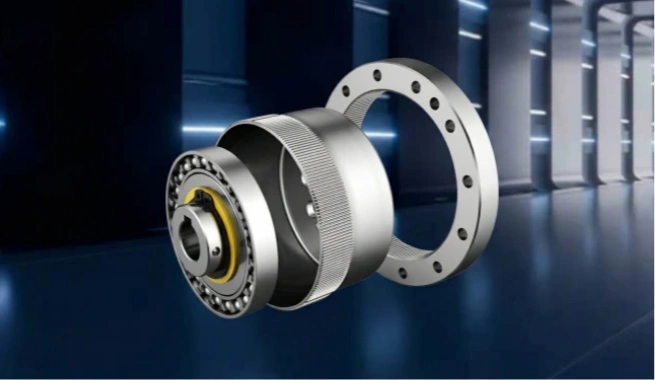
A standard strain wave gear consists of three fundamental components:
The Wave Generator: An elliptical cam enclosed within a thin-raced, flexible ball bearing. This is typically connected to the input shaft (the motor).
The Flexspline: A thin-walled, flexible metal cup or cylinder with external gear teeth machined around its open end. Due to the high cyclic fatigue it endures, it is manufactured from specialized, high-grade alloy steel.
The Circular Spline: A rigid steel ring with internal gear teeth. The Circular Spline always has a slightly higher number of teeth than the Flexspline (usually two more).
When the elliptical Wave Generator is inserted into the Flexspline, it forces the flexible metal into an elliptical shape. This causes the external teeth of the Flexspline to mesh with the internal teeth of the rigid Circular Spline at two opposite points across the major axis of the ellipse.
Because the Flexspline has fewer teeth than the Circular Spline, every full 360-degree rotation of the Wave Generator causes the Flexspline to rotate backward by a distance equal to the difference in tooth count (usually two teeth). This ingenious design allows for massive reduction ratios (e.g., 50:1, 100:1, 160:1) within a very short axial space.
More importantly, because about 30% of the gear teeth are engaged simultaneously at any given time, the load is distributed evenly. This multi-tooth engagement practically eliminates backlash, ensuring absolute precision and providing the high torsional stiffness required for smooth robotic motion.
While strain wave gears come in various configurations (such as "hat" or "flat" types), the cup-type design remains the gold standard for high-performance robotic joints.
In a cup-type reducer, the Flexspline is shaped like an elongated cup. The closed end of the cup (the diaphragm) provides a robust mounting flange, while the elongated flexible wall acts as a torsional spring, absorbing micro-vibrations and providing exceptional radial stability.
For robotics engineers demanding the highest tier of performance, selecting a premium component is non-negotiable. This is where advanced manufacturing solutions come into play. By integrating state-of-the-art materials and proprietary tooth profiles,Picea Motion Driveoffers highly optimized transmission solutions.
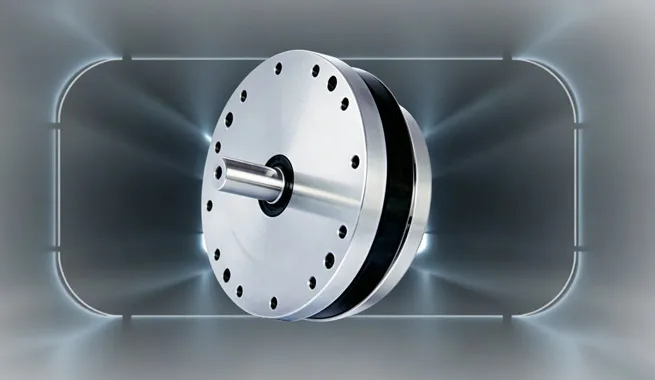
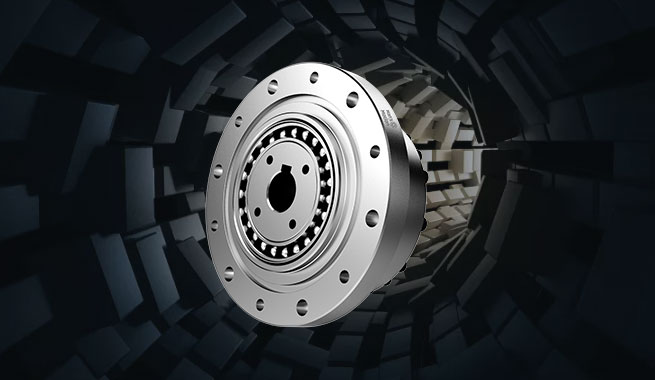
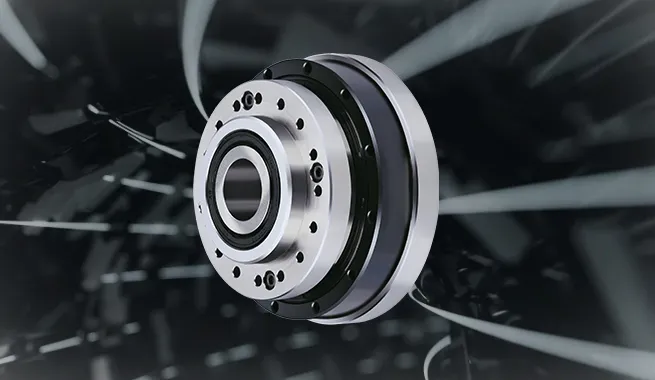
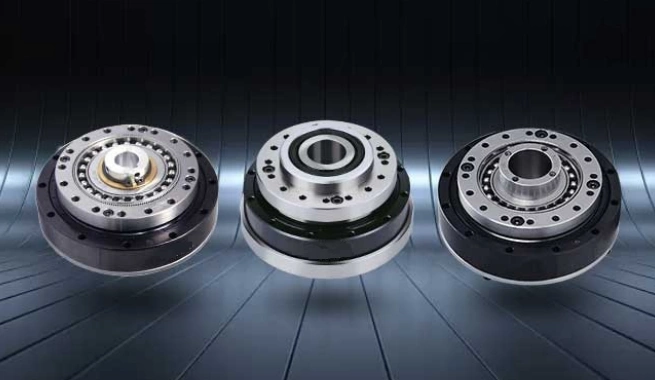
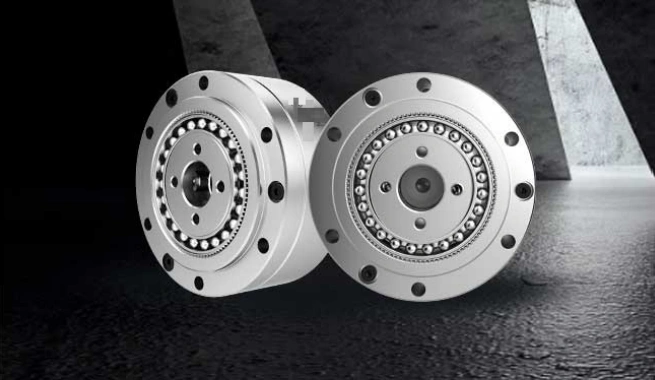
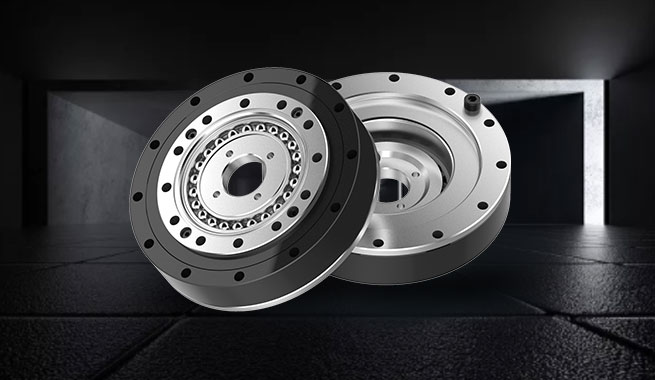
Specifically, theHMCG Series Cup-Type Strain Wave Gearrepresents the pinnacle of this technology. Engineered for high rigidity and immense torque capacity, the HMCG series allows cobot manufacturers to drastically reduce joint weight without compromising on load-bearing capabilities. Its superior cross-roller bearing integration supports high axial and radial loads, meaning engineers can connect the robotic arm directly to the reducer output, saving additional space and structural weight.
When optimizing a cobot joint and selecting a strain wave reducer, engineers must evaluate several critical technical parameters:
Peak Torque Capacity: Cobots frequently experience emergency stops or accidental collisions. The reducer must possess a high peak torque capacity to withstand these sudden shock loads without fracturing the Flexspline.
Torsional Stiffness: This refers to the reducer's resistance to twisting under load. High torsional stiffness prevents "springiness" in the robotic arm, allowing the control system to tune the motors more aggressively for faster cycle times.
Starting Torque and Friction: To maintain high efficiency and allow for sensitive force-feedback (crucial for cobot safety), the internal friction of the gear must be minimized. High-quality surface finishing on the gear teeth is vital here.
Lubrication Strategy: Strain wave gears can be lubricated with specialized grease or oil. For cobots, grease is generally preferred as it prevents leakage in joints that operate in various orientations, ensuring maintenance-free operation over thousands of hours.
TheHMCG Series Cup-Type Strain Wave Reducerexcels in all these metrics, providing a meticulously engineered balance of high stiffness, extremely low starting torque, and a robust thermal envelope for continuous industrial operation.
The integration of zero-backlash, cup-type strain wave reducers has expanded the operational horizons for collaborative robots across numerous industries:
In cleanroom environments, cobots are tasked with assembling delicate printed circuit boards (PCBs) or transferring fragile silicon wafers. The absolute positioning accuracy provided by strain wave technology ensures that sub-millimeter components are placed flawlessly, drastically reducing defect rates and material waste.
Perhaps the most demanding application of robotic joints is in the medical field. Surgical robots require movements that are smoother and more precise than a human surgeon's hand. The zero-backlash nature of strain wave reducers guarantees that surgical instruments move with perfect fidelity, eliminating any jitter or mechanical delay.
Cobots are frequently used to load and unload CNC machines. This requires the robotic arm to reach into confined spaces and secure heavy metal blanks with high repeatability. The compact size of cup-type reducers allows the robotic wrist to remain slim, avoiding collisions with the CNC machine's doors or internal fixtures.
As the robotics industry continues to evolve, the demand for even lighter, smaller, and stronger transmission systems will intensify. The rise of humanoid robots, which require dozens of compact joints, is already pushing the boundaries of mechanical engineering. We anticipate continuous advancements in metallurgical science and finite element analysis (FEA) to further refine the tooth profiles and fatigue life of the flexible spline components.
Furthermore, the integration of smart sensors directly into the strain wave reducer housing is on the horizon. This will enable predictive maintenance, allowing the robot to alert operators to potential gear wear long before a mechanical failure occurs, ensuring zero unplanned downtime in smart factories.
Optimizing a collaborative robot joint is a masterclass in compromise—balancing weight, power, safety, and precision. Traditional gearboxes simply cannot meet the multifaceted demands of modern cobot architecture.
The strain wave reducer, specifically the cup-type configuration, has proven itself as the definitive solution. By leveraging elastic kinematics, it delivers zero-backlash precision, massive torque density, and an ultra-compact footprint. For robotics OEMs and mechanical engineers looking to build reliable, high-performance automated systems, selecting the right transmission partner is the most critical design decision you will make.
By integrating industry-leading components like theHMCG Series Cup-Type Strain Wave Gear, you ensure that your robotic platforms are not only equipped to handle the manufacturing challenges of today but are also primed to lead the automation revolutions of tomorrow. Discover howPicea Motion Drivecan help you elevate your robotic engineering projects with world-class transmission technology.
Contact us today to discuss your project requirements and find the perfect harmonic drive solutions.
Contact Us Now
Hi, I am Sophie from Shenzhen PICEA Motion Technology Co, Ltd. I have been working in overseas business trade for more than 5 years. PICEA Motion is a professional manufacturer of precision harmonic gears. Our company integrates R&D, production, sales, and after-sales services.